

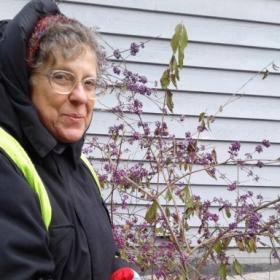
Irit Shimrat was a keynote speaker at the Mad Pasts, Mad Presence conference put on by Andrea White at the University of Victoria in April 2026.
Her speech, “Keep on Keeping on: The joys of solidarity,” was well received, and can be viewed here, courtesy of Ishaa Vinod Chopra’s YouTube channel, Ishaa Improv.
Ishaa, who kindly filmed Irit’s talk, is the author of Finding Order in Disorder.
The following is Irit’s Mad Pasts, Mad Prescence conference talk, as she wrote it:
Keep on keeping on: The joys of solidarity
It is so great to be here, and I am so grateful to Andrea for inviting me, and to you who have showed up for such an early-morning talk, and to everyone tuning in online. Thank you all.
In 1978, when I was 20 years old, I had three big shocks in a row. First, my father, who I lived with, told me he was getting married again and I’d have to move out. Then, a boy I was in love with dumped me. And finally, the university program I was sure would accept me, rejected me.
All that, plus a few hits of LSD, led to me going out of my mind. I had some beautiful visions and journeys – but I also started behaving oddly, which made the people around me fear for my safety. I spent most of the next two years in three different hospitals, being drugged against my will and made to feel physically wrecked, emotionally devastated, spiritually dead, and morally worthless.
In 1980, I escaped from the low-security hospital I was then locked up in. It was Movie Night. Movies were screened in a different building, and I had a bit of cash – so I just walked out the door, kept on walking, and then hopped a bus back home, feeling triumphant. Fortunately, I managed to avoid withdrawal psychosis, as I’d already been tapered off my “meds,” after I persuaded my shrink that I was stable and that the drugs were not doing me any good.
With a lot of luck, and a lot of help, I found a job and a place to live. A few years later, I met Don Weitz, a wonderful activist who hired me as editor of the antipsychiatry magazine Phoenix Rising. It was wild to discover that I wasn’t the only person on earth who had rejected the concept of “mental illness” after being hurt by psychiatry. And it was fabulous getting to publish psychiatric survivors’ articles, stories, poetry, and art.
Later, I helped start the Ontario Psychiatric Survivors’ Alliance. We got quite a pile of money from the provincial government’s mental health ministry, to fight back against some of its own programs, all in the guise of “partnership” and “consumer participation.” It was a different time.
I learned a lot about the fraudulence of psychiatric diagnoses. I discovered that the supposed mental illnesses listed in the diagnostic manuals – which determine how we will be drugged and “treated” – had never been proven to have any physical, measurable markers or causes. That, for each new edition of these manuals, psychiatrists would get together and vote on what would be deemed a disorder. That drug companies had a huge amount of control over what passes for professional education. That some top psychiatrists were even admitting the “chemical imbalance” theory had no basis in reality. Surely, I thought, we psychiatric survivors and our wonderful allies could change everything!
But … we couldn’t.
In fact, when Andrea first asked me to do a talk about the mad movement, I said, “What movement?” I felt that, after all these decades of so many people speaking out against the fake science psychiatry is based on, and the terrible damage it does, we hadn’t gotten anywhere at all. Indigenous, Black, disability, women’s, queer, and other movements had made sweeping changes to policy, practice, and public opinion. These days, of course, they all have to fight to maintain that progress, in a society that values power and profit above everything that is good. Still, I felt like our movement was the farthest behind, with psychiatric oppression, and the fear and loathing of crazy people, just getting worse and worse.
A while later, I was whining about this to a friend. She responded indignantly:
“How can you say the movement hasn’t accomplished anything,” she said. “The movement saved my life!” After listening to a radio show I’d presented years earlier, she wrote to the CBC to request the transcript. The bibliography listed a booklet called Dr. Caligari’s Psychiatric Drugs, which she promptly ordered. In it, she found advice on how to safely withdraw from so- called anti-psychotic medication, using a slow tapering method. She followed that advice, and ended a ten-year cycle of psychiatric incarcerations and constant forced drugging, which had destroyed the creativity that made her life worth living. She got her artistic mojo back, and was never psychiatrized again.
And I realized that our movement could only be seen as a failure if all we were trying to do was get rid of psychiatry and replace it with something better. Now, it’s true that the psychopharmaceutical-industrial complex is roaring along, making buckets of money while ruining countless lives. And yet – more and more people are questioning and criticizing psychiatry, and dissenting views are getting much easier to publicize. Many activists are planning, building, and putting into practice all kinds of alternatives to shoving people into diagnostic and physical boxes. And there are even places in the world where some progress has been made, at least on paper, in changing laws and policies.
True, the arguments against psychiatric hegemony are subject to vicious backlash. But they are also reaching more and more people who still have a chance to escape psychiatry, or to avoid ever going there in the first place. And, on a personal level – which is where the most important things happen – more and more of us are helping each other learn, fight back and, above all, not feel alone.
Because we are not alone. There are millions and millions of us all over the world, and so many ways of finding each other.
It’s important to acknowledge that people who have far less privilege than I do are often subjected to the cruellest psychiatric interventions. Indigenous people are way overrepresented in the worst psychiatric lock-ups. And, in general, non-white and non-English-speaking people, old people, poor people, those who don’t conform to sexual or other so-called norms, and many others, get much worse treatment than I ever did.
Fortunately, however, many people who don’t fit neatly into the little box of straight, white, able-bodied, affluent men have been speaking out and fighting back all along. Finding common cause with those who are supposedly different from us provides huge opportunities. When we listen deeply, we can begin to understand each other’s sorrows, joys, struggles, stories, traditions, and ways of healing and surviving. After all, isn’t difference what it’s all about? We get in trouble in the first place for thoughts and words and actions that don’t match what is expected of conforming human beings. So, learning to accommodate and appreciate all kinds of differences is at the core of what we do, and of who we are.
The more we can work together to expose the cruelty, ignorance and arrogance of psychiatry and other systems of oppression, the further ahead we will get, in the long run. And, in the short run, there is so much we can do to comfort, encourage and care for each other. And I’ve met so many crazies, from all walks of life, who are excellent, kind, smart, creative people, with so many talents, including a talent for joy, fun and connection.
When we engage in the work and play of building community, on no matter how small a scale, we are taking care of ourselves as well as each other. And there are plenty of things we can do without funding, which almost always comes with strings attached.
A long time ago, I started a tiny group called the Lunatics’ Liberation Front. We would get together once a week in my bachelor apartment. I’d provide a simple, inexpensive meal of rice and vegetables, and we’d each sit on one my two chairs, or on my fold-out couch, or on cushions on the floor, just eating and talking.
As in any group of psychiatric survivors, we didn’t have the hassle of starting from scratch, as we have to do with normies – explaining why everything they’ve been taught about the “helping professions” is wrong. Instead, we could get right into describing what had happened to each of us, how we got out (to the extent that we were out), and what actually helped us. And part of what helped us was exactly this: talking freely and openly, knowing we would not be interrupted or judged.
There is so much that psych survivors can do together besides just telling our stories, though doing so is vital to understanding what happened to us, and to feeling less alone and more alive. Organizing politically works for some of us. Participating in protests can feel empowering, even when few people show up or pay attention. Working to change legislation and policies is an important struggle in itself, even when progress feels slow or non-existent. I know quite a few brave souls who are working hard to get rid of bad laws, and/or to create possibilities for, and actual examples of, true, mutual social care. There is so much we can achieve, in person and online. And the “in person” part is crucial, so I’m really glad that Andrea has brought us together here.
To me, the most important thing we do together is having fun. Over the years, I have participated in poetry, creative writing and theatre groups; art-making sessions; dance lessons and parties; jam sessions and singalongs, and many other delightful experiences that free the mind and feed the soul.
One time, I took part in a session of improvised drumming at a mental health clubhouse a couple of us were visiting, as part of a project of the Psychiatric Survivors’ Alliance. When we got there, people were mostly sitting around drinking coffee and smoking cigarettes. (This was way back in the day, when smoking indoors was still allowed.) Most were kind of zombied-out on prescribed drugs, and were not interacting or even making eye contact. And then my colleague suggested that we head for the kitchen and make some noise. We found pots and pans to bang on, and spoons to bang on them with – and then . . . we all found our groove, making rhythm together, and everyone just came alive. It was glorious! I would never have guessed that such a thing was possible, and I have never forgotten it.
I have such fond memories of travelling around Ontario and stirring things up at clubhouses and elsewhere. I loved addressing audiences of psych survivors, allies, and sometimes even service providers; being interviewed; going to conferences and demonstrations and events. At that point I had been free of psychiatry for about a decade, and I was sure I would never be captured again.
A few years later, I moved from Toronto to Vancouver and mostly kept up my activism, in various forms, and thoroughly enjoyed being at large. And then I wrote my book, Call Me Crazy: Stories from the Mad Movement. Amazingly, I got a Canada Council grant to travel around the country and interview other activists. It was so exciting: taping, transcribing and editing the interviews; interspersing my story with other people’s; and then seeing my words in print – and even going on a little book tour, doing readings and getting applause.
But, it all went to my head, as they say. I lost what had seemed like my permanent, solid connection with consensus reality, and entered into an altered state that got labeled as mania, psychosis, et cetera. I started perceiving myself as the centre of the universe, and seeing and hearing things others did not. And, again, I got locked up and force-drugged – not once, but many times.
Usually it was just for a few days, because I quickly learned what to say to my keepers to convince them to let me go: “Thank you! I’m feeling much more settled now, and of course I’ll keep taking my meds, and see my psychiatrist, and report to the mental health team.” And then I’d stop taking the psych drugs as soon as I got out, and of course I never went to see the shrink, or the “team.”
But I did not, in fact, feel “settled” – quite the opposite. I was using a lot of powerful recreational drugs, and I was in a relationship that wasn’t working out, and felt crushing guilt and grief about not being able to love someone who loved me very much. Around the turn of the millennium, I had a couple of longer lock-ups – six weeks each – and more intense drugging, along with the humiliation, isolation, shackles, and other forms of torture that constitute forced psychiatric treatment.
And, oh, I was so hurt and angry. How could this be happening to me, again, after all my activism and organizing and publishing and everything. Why had none of that protected me? How dare the movement fail me?
But actually, the movement never failed me. Along with a few old friends and even a couple of family members, my activist comrades were very much there for me, and helped me survive and get out.
One time, I was locked up at St. Joseph’s in Comox, and I made a collect call to David Oaks. David is a movement giant, who founded the Support Coalition International, which later became MindFreedom International. I told him I was locked up again, and all I could think about was killing myself. He told me I mustn’t kill myself, because the movement needed me. He also stressed that I must never say this kind of thing in front of a nurse or a psychiatrist. Most importantly, he suggested that I should think of my hospital stay, not as being locked up, but as doing field work. This made me laugh, and I hadn’t laughed in a long time. That phone call, together with my strong bonds with fellow patients, people from my previous life, and even the one nice nurse on the ward, helped make me strong enough to keep on going.
This was in the summer of 2007. In January of that year, my mother had died. And in February, my ex-lover and beloved friend Chris died. I had been living with her on a little island off the coast since 2001, when she’d rescued me from Vancouver General Hospital. With those devastating losses, my life fell apart, and I became helpless and hopeless and miserable – and extremely crazy. I believed that the radio was talking directly to me, and that I was the object of some vast conspiracy. My neighbours got alarmed when I started throwing stuff into the yard, and responding to their greetings with loud crow calls. They alerted the authorities.
And, of course, the “professional help” I got – from police dragging me to the bin, from callous orderlies and nurses, and from the clueless, arrogant psychiatrist who drugged me into oblivion – made it all so much worse. I believe that, if I’d been treated with kindness and calm and dignity, instead of panic and force, it could have been very different. But, I got through it, and got free again – and here I am.
I have since realized how lucky I was to escape outpatient committal. Too many of my friends have not been so fortunate. They have been released from hospital, but only conditionally. If they don’t see their mental health teams and don’t take the mandated pills or shots – which they all hate – they can be stuffed back into the loony bin. And, right now, I have one friend who has been languishing for months on end on a “long-term-care” ward. She was evicted before being locked up, so there’s nowhere to release her to. One thing after another is going wrong with her body, as they drug and drug and drug her. But, even under these horrible circumstances, the time we spend together – whether in person, online, or on the phone – does a world of good, for both of us. We understand and nurture each other. And, in between the bouts of rage and grief, we often make each other laugh.
I am continually amazed by the ability of my psychiatrized friends to keep on keeping on. I, who have been psychiatry-free for so many years now, still sometimes spiral into rage and despair and self-loathing. When my energy goes into viciously putting myself down, I feel like I’m doing psychiatry’s work for it. I also panic about any change in my routine – I’ve been freaking out pretty badly about being away from home for this conference. I thought I might be too fragile to survive even one night away from my own bed.
And so many of us go through this sort of thing, because we’ve internalized the idea of our own worthlessness and hopelessness and inability to cope with our private difficulties, and with this increasingly strange and scary world we’re all living in. We feel isolated and weak and frightened, and this is by design. Psychiatry wants us to feel desperate, helpless, alone and defeated, so that we don’t start thinking for ourselves, and organizing, and resisting.
As wars keep being waged and more and more lives and basic rights are threatened or ended by the powers that be, many people who have never worried about going mad, or thought of themselves as mad, are now feeling like they might be losing it. Nobody seems to have any control over the apocalyptic events we lucky ones are just following on the news.
The mad movement is needed now, more than ever, as madness looms large, and increasingly repressive measures are taken to deal with it. The idea of “mental illness,” and the fear of it, are so ingrained that people in other social movements often have progressive views on everything else, but not madness. This might end up changing as things get weirder.
As my friend Will Hall recently wrote in an essay on solidarity: “I believe as mad activists we have something unique to offer. We know about self-care and community care and we know about seeing through labels. Mad activists can play a crucial role in the struggle to end the empire that dehumanizes, oppresses, kidnaps, and kills us. We embody healing and hope just by being alive. Our intuitions and visions and courage are vital ingredients for real social change.”
Will’s words hit home for me. As the years go by, I keep being wowed by the bravery, goodness and brilliance of the psych survivors and close allies in my life. I’m actually glad I got locked up a bunch of times. It’s beautiful to have this instant, easy rapport with total strangers who’ve had similar experiences. And I have learned so much, and done so much meaningful, satisfying work – and had so much fun.
I’ve figured out how to mostly keep myself together in other ways, too – by writing, reading, and practising various movement and breathing techniques. By spending time outside, grooving on trees and flowers and water and wind and mountains and clouds. By letting music move through me. By finding things that make me laugh.
I’m also less freaked out about not always keeping myself together. (I think being old helps with that.) Still, at the top of my list of what helps me, and makes my life worth living, is the wonder of true, warm, vibrant contact with other beings, notably including human ones.
And so much of what I’ve learned, I’ve learned from other mad people.
In a world where war is sold as peace – where selfishness and greed are touted as virtues, where everything is commodified and monetized, where compassion and empathy are scorned by the rich and powerful, and where the “mental health” industry is big, big business, and keeps growing all the time – we can still be the glue that holds ourselves and each other together. We can keep reminding each other of what’s really important: joy, connection, kindness, respect. As one of my psych survivor friends says: “Open heart, open mind, open eyes.” We carry on, kept afloat by hope, laughter, and solidarity.