

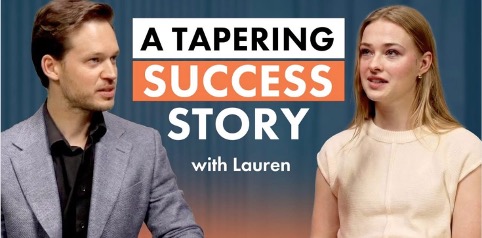
This is a success story
Of coming off antidepressants – enduring severe withdrawal – and
reclaiming life.
At fourteen, Lauren believed she was broken.
She didn’t think she was “clinically depressed.” That word came later, when a doctor told her she was. But the feeling of defectiveness was already there. Something must be wrong with me, she thought. Nothing else could explain why she hurt so much, why she cut herself, or why she sometimes didn’t want to live.
It’s the kind of story psychiatry meets every day. A young person in pain, parents in chaos, a desperate wish for control, and an equally strong need to understand. And it’s also the kind of story psychiatry still rarely listens to.
Last month, Lauren joined me in Copenhagen for a conversation about her story. We rented a podcast studio, fired up the cameras, and started talking. In the episode – coming soon here – she walks us through her journey: before the medication, during it, and through the severe withdrawal that hit her when she followed her doctor’s advice on how to stop her antidepressant.
It’s a story about sense-making, survival, and what happens when the human experience is mistaken for a chemical defect.
When the episode goes live on my YouTube channel later this month, you’ll hear the full dialogue. Our voices, the pauses, the laughter, and the tears.
Until then, I wanted to share the outline of it here. Because what happened to Lauren is what’s happening to thousands around the world. Every day.
Chapter one: Before the diagnosis. What surrounded the suffering?
She began with her family. “My childhood was chaotic,” she said. “My dad was a workaholic – stressed, running a million projects at once, not emotionally available. My mom was overwhelmed and couldn’t handle her own emotions, let alone ours.”
Lauren was one of five children. She recalls trying to hold the family together (not a kid’s job! – which was the first trauma), especially for her older brother, who struggled with suicidal thoughts.
At fourteen, she was cutting herself, restricting food, anxious, and depressed. But behind those words was something more fundamental: unpredictability, inconsistency, and the unbearable feeling of not being seen – something we can only expect a person to react (and adapt) to.
“I would go to my mom and ask what was going on in our family. Why everything was so chaotic. She’d say, ‘Everything’s fine.’”
That line – everything’s fine – is where so many emotional disorders begin.
Because when a child’s reality is denied, the only remaining explanation is internal: Then something must be wrong with me.
Lauren was right in her reading of the family dynamics. Something was wrong, and she sensed it. But in this part of her story, that truth wasn’t validated.
And so, Lauren learned not to trust her feelings. Not to trust her perception. And when you can’t trust what you feel, you can’t trust yourself, and when you can’t trust yourself, the world becomes unsafe. Without that inner emotional compass I talk about in Chapter 8 of my book, you start navigating by everyone else’s map.
Combined, it’s the perfect breeding ground for self-blame; and the perfect opening for psychiatry to enter with its promise of certainty and explanation.
Chapter two: The diagnosis
At fourteen, Lauren was sent to a treatment center. Within a day she was diagnosed with major depression and prescribed an antidepressant.
“They didn’t ask much,” she recalled. “I maybe had one therapy session. They just said: you have depression.”
For a moment, it felt good. I suppose it was validation I felt, validation disguised as diagnosis.
“It finally put a name to what I was feeling,” she said. “It made me think: maybe I’m not crazy. Maybe this is real.”
That’s one of psychiatry’s most seductive offerings: an explanation that stops the search for one, which, in itself, can be relieving. The word depression becomes both comfort and cage, like a double-edged sword. It tells you what’s wrong, and simultaneously tells you it’s inside you.
When Lauren asked the psychiatrist how long she would need the medication, he told her, probably for life, as she “likely had a chemical imbalance and depression in her genes.”
At age fourteen!
At fourteen, they tell people this?
In one conversation, a fourteen-year-old’s attempts to survive her toxic environment were turned into a lifelong disease.
Chapter three: The numb years
She was switched from Zoloft to Prozac to Celexa to Lexapro – until they found one that didn’t make her too tired or too anxious.
“So I assumed it must be working,” she said. “Since it didn’t hurt me.”
That’s how many people end up staying on medication; not because they feel truly well, but because the doctor’s neurobabble makes them believe they’re ill, and not feeling worse passes for getting better.
After all, she believed it was fixing something broken in her brain. Like so many others in modern Western psychiatry, she was told it was biological, genetic, lifelong. And she believed it, because everyone around her did and it was presented with such authority.
But slowly, imperceptibly, the drug began to dull her inner world.
“It made me completely exhausted,” she said. “I would sleep fourteen hours a day. I thought that was just who I was.”
It wasn’t just the lows that disappeared. It was the highs too.
The sadness was quieter, but so was joy, creativity, and the small things that make a life feel real. The medication flattened Lauren’s emotional range. In a metaphor, it quieted the alarm of her nervous system without resolving what the alarm was trying to say.
The real tragedy is that, within the treatment center, she actually had what she needed: human connection, safety, someone listening.
“Looking back,” she said, “it wasn’t the medication that helped me. It was being surrounded by people who cared.” But that’s far too simple an explanation for psychiatry to accept. And so, psychiatry credited the drug for what belonging and time had done.
Chapter four: The turning point
Her husband, Cayden, started asking questions she had never been asked: Who are you? What do you want?
He didn’t buy the story that she was fundamentally broken.
At the same time, she came across a book about trauma – one that explained that trauma isn’t only what happens to us, but also what doesn’t happen: the absence of emotional safety, validation, and consistency.
“It said trauma can be not getting what you needed,” she told me. “And that was the moment I realized: oh – that’s me.”
Her father’s eventual imprisonment for financial crimes confirmed what she had always sensed as a child: that the chaos wasn’t in her, it was around her.
For the first time, the equation flipped.
There wasn’t something wrong with her. There had been something wrong with her environment.
“That realization was liberating,” she said. “It sent me on a two-year stretch with no depression at all.”
This is what happens when people are finally given context instead of chemistry.
Their story starts to make sense.
Chapter five: The withdrawal
“But you’re young, so you’ll be fine,” she recalled him saying.
That offhand comment planted a seed: Maybe this drug isn’t as harmless as I thought.
So she asked how to come off. The doctor gave the standard advice: cut the dose in half every few weeks until you’re off.
And then hell broke loose.
“From five milligrams to zero,” she said, “it was like my brain exploded.”
She described the symptoms:
– bugs crawling under her skin
– extreme sensitivity to light and sound
– sudden rage and irritability
– depersonalization – feeling like she wasn’t in reality.
“I was the agreeable type,” she said. “I was never angry. Then suddenly I was enraged at everything. I didn’t recognize myself.”
It’s a kind of suffering mainstream psychiatry still refuses to believe in. The official descriptions call antidepressant withdrawal mild and self-limiting. But as Lauren put it, “It was the worst thing I’ve ever experienced.”
In desperation – like so many others – she went online. There she found other people describing the same thing: the shock of battling unexpected withdrawal. Hundreds. Thousands! She found Facebook groups, survivor forums, videos.
And one day, she found mine.
“I watched every single one,” she said. “You were the first person who said I wasn’t going crazy.” That validation – that it was withdrawal – helped her hang on. Already many months into withdrawal, she decided not to go back on the drug, but endure.
“I knew if I went to a hospital,” she said, “they’d just give me more drugs. So I stayed home and waited it out.”
For months, Lauren woke up in panic, drenched in adrenaline. She couldn’t trust her senses, her moods, her perception of time. But underneath the chaos, something was reorganizing itself. The body was trying – slowly, stubbornly – to find equilibrium again.
And so, it did. It took eight months. Gradually, the symptoms softened. First the physical ones. Then the fear. Then, slowly, her emotions began to return.
“It feels like I’ve been asleep for twelve years,” she said. “And I just woke up.”
That’s the paradox of recovery: the pain ends not because you succeed in suppressing or controlling it, but because you can feel again and learn to understand its message.
Chapter six: After the numbness
What replaced the emotional numbness was the full spectrum of human emotions.
“Now I can actually cry,” she said, smiling. “And it feels good.”
Lauren still has ordinary ups and downs, but they make sense (as do yours and mine).
She speaks with clarity about what she learned:
- That cutting and restricting food were strategies; her way of gaining control in chaos.
- That depression wasn’t a random illness inside her but a reaction to the denial of her emotions.
- That what she needed was understanding and someone to help her navigate those deep feelings inside.
When I listen back to our conversation, I’m struck by how coherent it all becomes once you remove the medical lens. That is, once you use ordinary words for difficult things.
Nothing about Lauren’s story is random. Every so-called “symptom” was an emotion, a form of sense-making, or a survival strategy during crises or trauma.
It’s why I keep returning to the Power Threat Meaning Framework (PTMF) in my clinical work. Before we turn to any diagnostic language, we should always begin with these four simple, human questions:
1. “What has happened to you?”
2. “How did it affect you?”
3. “What did you have to do to survive?”
4. “What sense did you make of it at the time?”
These questions apply to all of us. Before we pathologize, we can always begin here.
Chapter seven: What her story shows us
Compassion and context. Remember those!
When I asked her what she’d like to say to people still stuck in withdrawal, she didn’t hesitate.
“That they’re not alone,” she said. “That they will heal. Even if they tapered wrong, even if it feels impossible – the body knows how to find its way back.”
And then she paused.
“I just wish someone had told me earlier that it all made sense.”
Growing Up on SSRIs: Lauren’s Lexapro Withdrawal, Taper & Recovery Story | Full Interview
What happens when a 14-year-old girl is told she has a “chemical imbalance” and will need SSRI medication for life? And what happens twelve years later, when she tries to come off it, exactly as instructed by her doctor?*
This is Lauren’s story.
It’s one of the clearest examples I’ve ever heard of what modern psychiatry gets wrong, and what a trauma-informed lens can make clear.
In this conversation, filmed in Copenhagen, Lauren and I talk through her journey:
– the chaos of her childhood
– the diagnosis that replaced her story and context with chemistry
– twelve years of emotional numbness
– the severe antidepressant withdrawal that hit when she tapered the way she was told
– and the moment her life finally began making sense again.
Her story is not rare. It’s happening to hundreds of thousands of people right now.
If you or someone you love has ever struggled on antidepressants, wondered about withdrawal and hyperbolic tapering, or questioned the “chemical imbalance” narrative – this dialogue is for you.